
CPF Property Pledging: Withdraw from Your RA, Eligibility and Does It Makes Sense

CPF Property Pledging lets eligible Singapore property owners withdraw part of their Retirement Account (RA) savings by pledging a residential property as security. This strategy can free cash for investment, debt repayment or life goals, but it reduces CPF Life payouts and forfeits guaranteed RA interest on withdrawn funds.
This guide explains exactly how CPF Property Pledging works, who can do it, how much you can withdraw, the mechanics when you sell a property, the financial trade-offs, common pitfalls etc. Do read the excellent CPF web site for more details or contact us for more help !
At-a-glance: What you need to know about CPF Property Pledging
- Purpose: Convert a portion of your RA into cash by pledging a qualifying residential property.
- Eligibility: Property must be in Singapore and lease must last to at least age 95; your RA balance must be at least the Basic Retirement Sum (BRS) for your cohort at age 55.
- Withdrawal cap: The maximum you can withdraw equals your cohort Full Retirement Sum (FRS) minus the cohort Basic Retirement Sum (BRS) for the year you turn 55.
- Permanent cap timing: The maximum amount is fixed based on the FRS/BRS for the cohort year when you turn 55 and generally cannot increase later.
- Effect: Reduces CPF Life annuity payouts and removes the 4% guaranteed RA growth on withdrawn money.
Definition: What is CPF Property Pledging?
CPF Property Pledging is a formal arrangement where a qualifying residential property is used as a pledge to allow an owner to withdraw CPF savings from their Retirement Account (RA) above the Basic Retirement Sum. The pledge is a legal promise to CPF that the owner will return CPF principal and accrued interest to the CPF accounts when proceeds from the subsequent property sale are available.
Importantly, pledging does not transfer ownership of the property to CPF. It is a security interest against the property: if you sell, CPF has first claim on funds needed to restore CPF balances as required.
Who should read this
This article is for Singapore residents and property owners considering using CPF Property Pledging to free up CPF funds from their RA after age 55, or for those evaluating the retirement income trade-offs before pledging. It is also for younger people planning their retirement cash flow, or who want to understand the implications of pledging on CPF Life payouts.

Eligibility: When can you use CPF Property Pledging?
Two tests determine eligibility for CPF Property Pledging:
1. Property criteria
- Property must be a residential property located in Singapore.
- Lease remaining (for leasehold properties) must extend to age 95 or beyond for the owner at the time of assessment.
- Type (HDB, private condo, landed) and whether CPF was used to buy it do not affect eligibility. Both fully paid properties and mortgaged properties qualify.
2. Retirement Account balance
Eligibility also depends on the Retirement Account balance created at age 55. The key threshold is the Basic Retirement Sum (BRS) for your cohort in the year you turn 55. If your RA balance after the standard CPF transfers is at least the BRS, you are eligible to pledge a property and withdraw the permitted amount.
How the RA is filled at age 55:
- CPF transfers funds from Special Account (SA) first, then Ordinary Account (OA), to top up the RA up to the Full Retirement Sum (FRS).
- If you do not have enough in SA and OA to reach FRS, your RA equals the available balance and may be less than FRS.
- As long as RA is at or above BRS, you meet the RA eligibility test for property pledging.
How much can you withdraw with CPF Property Pledging?
The governing rule is straightforward: you can withdraw the portion of your RA that exceeds the Basic Retirement Sum (BRS), subject to a cohort cap. The maximum withdrawal amount equals:
Maximum withdrawal = Cohort FRS − Cohort BRS

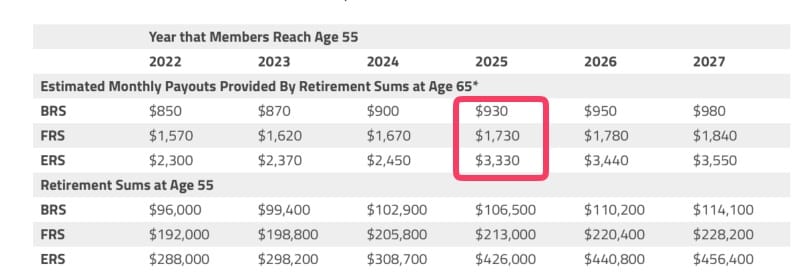
"Cohort" means the BRS and FRS values for the calendar year when you turn 55. That fixed difference sets the ceiling you cannot exceed, even if RA contributions or FRS/BRS rates rise later. Read about the latest announced BRS and FRS sums here.
If in doubt, contact a licensed property agent to help you 😸
Practical examples
Example numbers (illustrative): suppose your cohort FRS is $220,400 and BRS is $110,200; then the maximum withdrawal via CPF Property Pledging is $110,200.
Scenario A: RA balance equals FRS ($220,400)
- RA above BRS = $220,400 − $110,200 = $110,200
- You can withdraw up to $110,200 if your property residual value allows.
Scenario B: RA balance is below FRS, say $200,000
- RA above BRS = $200,000 − $110,200 = $89,800
- You can withdraw up to $89,800 if property residual value allows.
Note: Only actual CPF contributions count towards the amount you may withdraw. Voluntary top-ups, interest credited, or government grants typically cannot be withdrawn.
How CPF treats proceeds when you sell a pledged property
When a pledged property is sold, CPF repayment follows a strict priority order to protect retirement funding:
- First, any shortfall that auto-pledging reserved to fill up the RA to the FRS is repaid.
- Second, any amount you actually withdrew using CPF Property Pledging (principle plus accrued CPF interest) must be returned.
- Third, any remaining repayment goes to the OA or other CPF accounts as applicable.
The repayment includes both principal withdrawn from CPF and the accrued interest that would have been credited had the funds remained in CPF. This ensures CPF balances are restored to the required levels.
How CPF Property Pledging affects CPF Life and guaranteed interest
Two critical retirement consequences of CPF Property Pledging:
1. Lower CPF Life monthly payouts
CPF Life payouts are calculated based on the amount in your RA used to buy a CPF Life annuity. Withdrawing funds from RA reduces the annuity base, which lowers monthly CPF Life payouts for life. Example:
- Someone with FRS funding might expect a CPF Life payout of around $1,730 per month at age 65 (example figure).
- If the RA is reduced to BRS only because of pledging, CPF Life payout might drop to around $930 per month (illustrative).
2. Loss of guaranteed RA growth on withdrawn funds
RA funds earn a guaranteed interest rate (commonly around 4% for the first $60,000 in combined CPF balances, with a higher rate nil on some components).
When you withdraw RA funds, those funds no longer earn that compounded interest in CPF. You must consider whether the withdrawn funds can be deployed to earn returns that match or exceed CPF’s guaranteed rate and whether the trade-off is worth the reduction in lifetime annuity.
Don't anyhow give your CPF Property Pledging funds to your new found foreign girlfriend or the cute XMM okay 🙂

Pros and cons: Is CPF Property Pledging right for you?
Pros
- Access to cash: Converts part of RA into liquid funds for spending or investment.
- Flexibility: You do not have to withdraw the full permitted amount — you can pledge and only withdraw what you need.
- No loss of title: Pledging does not transfer property ownership to CPF.
- Can be used by owners who bought with cash or CPF: Both types of buyers can pledge, subject to residual value tests.
Cons
- Lower lifetime annuity: CPF Life monthly payouts are permanently reduced if you withdraw RA funds.
- Loss of guaranteed CPF growth: Withdrawn funds stop earning CPF interest.
- Repayment obligation on sale: When the property is sold, funds must be returned to CPF to restore required balances; this can reduce net proceeds.
- Co-owner consent: All co-owners must consent to pledging.
Practical step-by-step: How to pledge a property and withdraw from your RA
- Check eligibility: Confirm the property location and lease eligibility, and verify your RA is at least the BRS for your cohort.
- Check residual property value: CPF will assess the residual CPF-repayable amount available from your property (market value minus outstanding mortgage and co-owner CPF usage) and apply your ownership share.
- Confirm maximum permitted withdrawal: This is cohort FRS minus cohort BRS and is fixed based on the year you turn 55.
- Decide the withdrawal amount: You can pledge and withdraw up to the permitted limit but you may choose a smaller amount. Consider leaving more in RA to preserve CPF Life income.
- Obtain co-owner consent: All co-owners must agree to the pledge and withdrawal.
- Submit application to CPF or approved channels: Follow CPF’s online or paper application procedures and provide required documentation, including proof of ownership.
- Record and plan for repayment: Understand the repayment priority if the property is sold: first auto-pledge shortfall, then withdrawn amounts plus accrued interest, then remaining goes to OA or owners.
Common scenarios and edge cases
Scenario: Property fully paid up versus mortgaged
Whether the property is fully paid or still mortgaged does not determine eligibility. CPF calculates how much is available to CPF by taking market valuation, subtracting outstanding mortgage balance and any CPF funds previously used by any co-owner. The resulting residual value, multiplied by your ownership share, is the amount CPF can claim against.
Scenario: You did not use CPF to buy the property
Even when the property was bought entirely with cash, you may still pledge. CPF will use market valuation minus mortgage (if any) and co-owner CPF usage to compute residual CPF-repayable value. The absence of prior CPF usage does not disqualify you.
Scenario: Joint tenancy and ownership percentage
A common misconception is that joint tenancy means 50/50 ownership. For CPF residual value calculations, joint tenancy is often treated as 100% ownership for each owner for certain CPF accounting purposes. This can affect the amount you are permitted to withdraw. Check CPF’s specific rules for ownership types and confirm the computed share before acting.
Scenario: Top-ups and Enhanced Retirement Sum (ERS)
Voluntary top-ups to CPF and topping up to the Enhanced Retirement Sum do not increase the maximum allowable withdrawal under CPF Property Pledging. The withdrawal cap remains cohort FRS minus cohort BRS. Voluntary top-ups are excluded from amounts you can withdraw.
Scenario: Pledging after starting CPF Life payouts
You generally must decide to pledge before CPF Life payouts commence. Once CPF Life begins and CPF Life premiums have been fully taken from your RA (as occurs under certain plans), there may be little or nothing left in RA to pledge or withdraw. If you are on the Basic plan and some RA remains unconverted, pledging might still be possible; otherwise pledging is usually no longer an option after CPF Life starts. That's because the RA money already left your RA to purchase the CPF Life.
CPF Property Pledging: Frequently Asked Questions
Q: Does pledging transfer ownership of my property to CPF?
A: No. CPF Property Pledging is a security interest. Ownership remains with you. CPF has a priority claim on proceeds for CPF-related repayments if the property is sold.
Q: Must the property be fully paid up to pledge?
A: No. Both fully paid properties and mortgaged properties can be pledged. CPF will deduct outstanding mortgage and any co-owner CPF usage from market value to determine residual value available to CPF.
Q: Can I pledge a property bought entirely with cash?
A: Yes. Purchasing with cash does not prevent pledging. CPF will use valuation minus mortgage and co-owner CPF usage to compute the amount available for claim and apply your ownership percentage.
Q: I have co-owners. Do they need to consent?
A: Yes. All co-owners must consent to pledging because the pledge creates an interest against the property that affects ownership rights and proceeds distribution.
Q: If I sell the property, how is repayment applied?
A: Repayment order is: (1) auto-pledge shortfall to top up RA to FRS; (2) any amounts you withdrew through pledging (principal plus accrued CPF interest); (3) remaining proceeds returned to OA or distributed among co-owners per ownership arrangement.
Q: Can I pledge after I turn 55? Is there a deadline?
A: You can pledge any time after age 55, but you must do so before CPF Life payouts start. Once CPF Life premiums have been deducted from RA under certain plans, there may be nothing left in RA to pledge.
Q: If I top up my RA to the Enhanced Retirement Sum, does that change how much I can withdraw by pledging?
A: No. Voluntary top-ups do not affect the withdrawal cap. The maximum is still cohort FRS minus cohort BRS.
Q: Will CPF accept joint tenancy as a 50% share?
A: CPF treats ownership depending on the legal structure. Joint tenancy is frequently recorded in CPF systems as 100% ownership for each owner in certain contexts. The residual value available to you is calculated according to CPF’s formulas, so check CPF’s computed figure for your exact entitlement.
Q: What components of my CPF count for withdrawal eligibility?
A: Only actual CPF contributions in the RA count towards the balance used to calculate how much above the BRS you can withdraw. Voluntary top-ups and interest earned are generally excluded for withdrawal purposes.
Summary
CPF Property Pledging is a powerful tool to access funds from your Retirement Account by using a Singapore residential property as security. It can boost liquidity but carries permanent consequences for CPF Life income and guaranteed CPF interest.
The maximum withdrawal is determined by cohort FRS minus cohort BRS for the year you turn 55 and is subject to property residual value and ownership share. Auto-pledging can lock in shortfalls to FRS, meaning the withdrawal ceiling seldom increases later.
CPF Property Pledging is a legitimate option to unlock CPF funds, but it should be treated as a strategic retirement decision rather than simply a source of cash.
Carefully weigh the immediate benefits against long-term retirement income reduction and the need to restore CPF balances when property proceeds return to CPF upon sale.
Key terms quick reference
- CPF Property Pledging: Using a residential property as security to withdraw RA funds above BRS.
- RA: Retirement Account created at age 55.
- BRS: Basic Retirement Sum — minimum amount required in RA for standard CPF Life eligibility.
- FRS: Full Retirement Sum — the benchmark for higher CPF Life payouts.
- Auto-pledging: CPF’s automatic reservation on property proceeds to fill any RA shortfall to FRS when the property is sold.


Member discussion