
HUDC Flats in Singapore: What They Are, Why They Exist, and What You Must Know Before Buying or Selling One
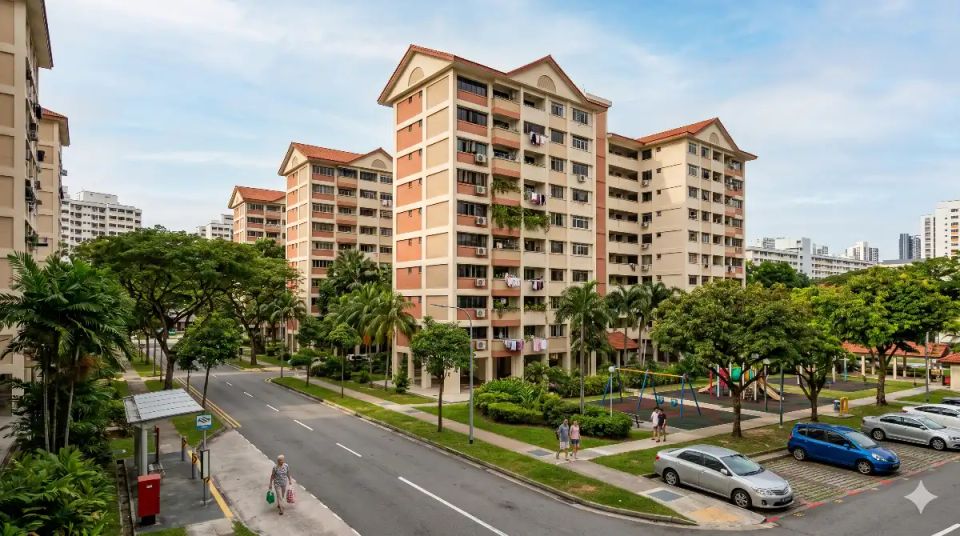
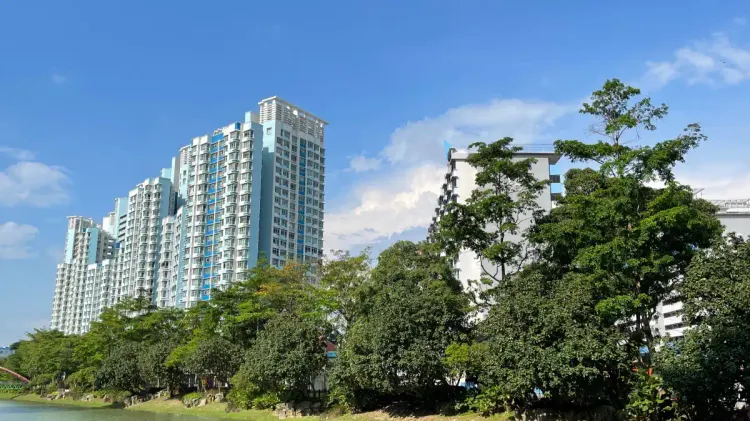
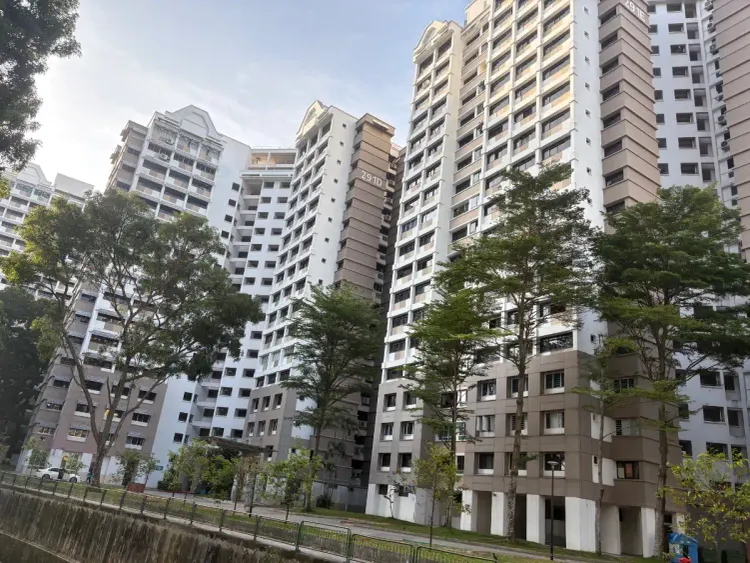
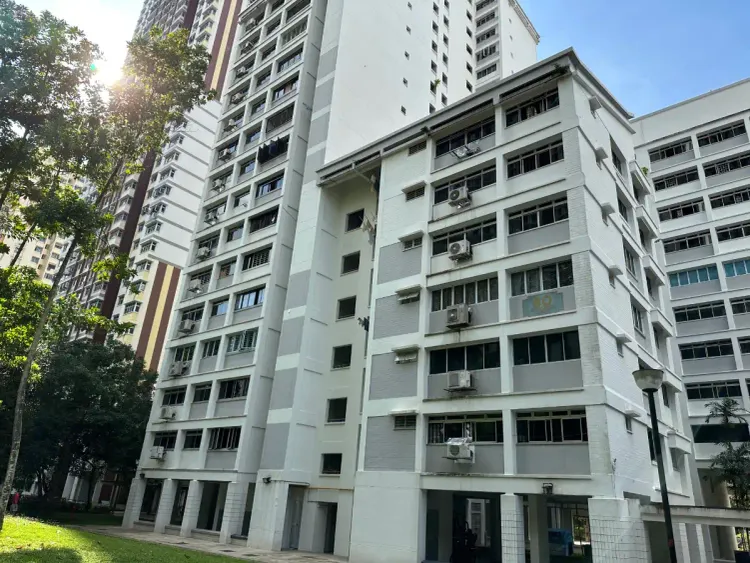
You walk past a block in Bishan or Braddell that looks exactly like an HDB estate — same era, same aesthetic, same void deck — but someone tells you it is private property. And you think, wait, how 😛
That is a HUDC flat. And the distinction matters a lot more than most people realise, especially if you are thinking of buying or selling one.
Here is what you need to know...
The Short History: The Sandwich Class Problem
In the 1970s, Singapore had a housing gap. HDB flats were for lower and middle-income households. Private condominiums were expensive, mostly out of reach for the average mid-career professional. The people caught in between — earning too much to qualify for HDB but not enough to comfortably buy private — had nowhere obvious to go.
The government's answer was the Housing and Urban Development Company (HUDC), set up in 1974. HUDC developed a category of housing specifically for this "sandwiched class": flats that looked and felt like HDB in terms of design and scale, but with larger unit sizes and better finishes, targeted at higher-income households.
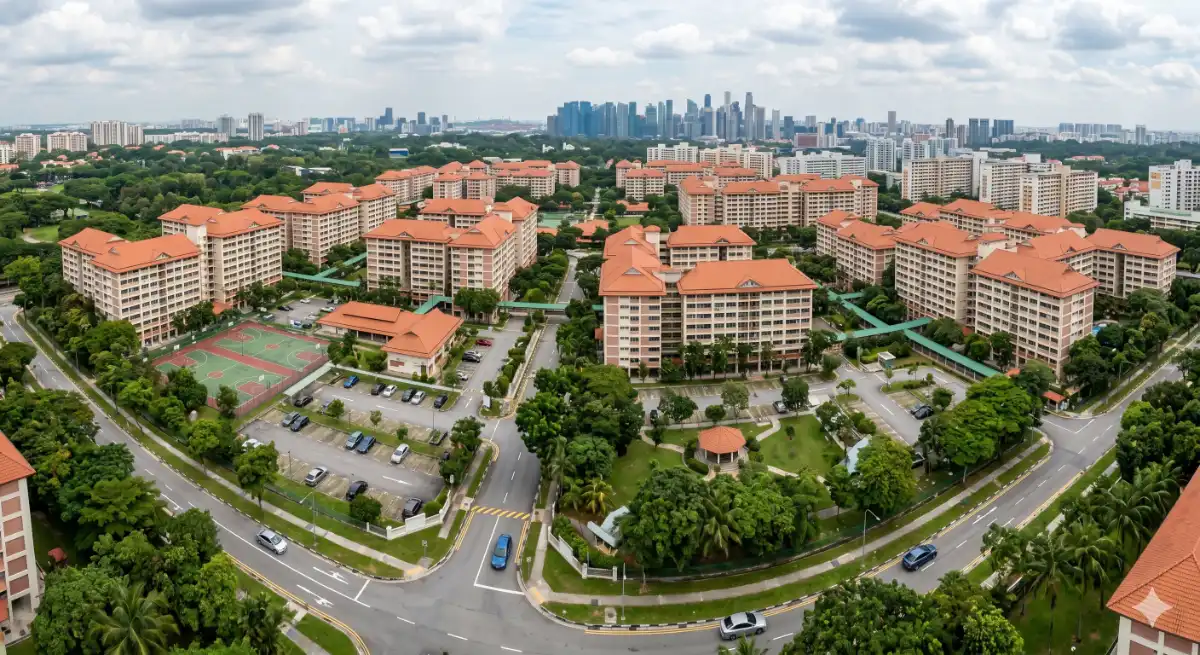
Construction ran through the late 1970s and 1980s. Estates like Braddell View, Farrer Court, Pine Grove, Tampines Court, Eunosville, and Shunfu Ville were built under this scheme (list of HUDC flats).
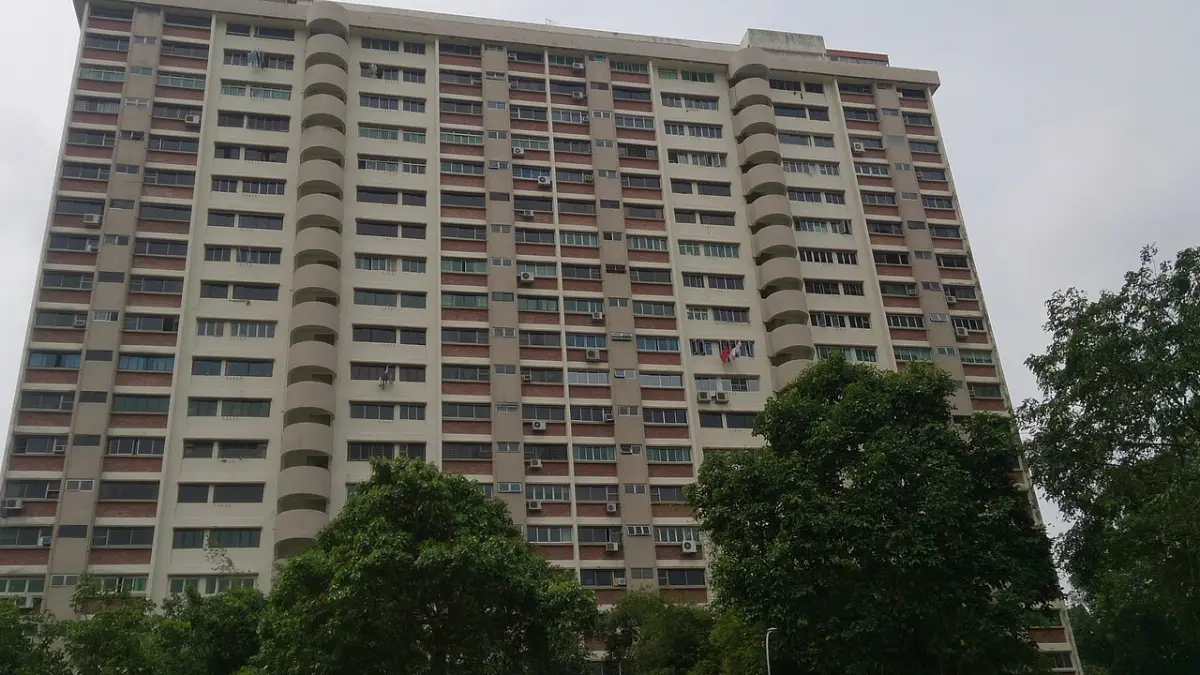
Then came privatisation. Between 1995 and 2002, all HUDC estates were converted to private property status. Residents received strata titles, Management Corporation Strata Title (MCST) bodies were formed, and just like that — what used to be a quasi-public flat became a private condominium.
Tata. Huat Ah. HUDC became Private condo !! Huat to the MAX MAX 😀
That single lottery act of privatisation is the root of everything that makes HUDC flats interesting today.
What Makes HUDC Flats Different From Regular HDB and Regular Condos
HUDC flats sit in a category of their own. They look like HDB (and honestly they do... but they are larger in land size and unit size lo). They were originally sold like HDB. But they are governed like private condominiums. Here are the most important differences:
1. Private Property Status — With All the Implications
Since privatisation, HUDC flats are classified as private residential property. Not HDB. This changes almost everything about the rules that apply to you.
There is no ethnic integration quota (EIP). You do not need to check racial quotas before buying or selling. There is no income ceiling. There is no Minimum Occupation Period (MOP) requirement. You can rent out the entire flat immediately after purchase without needing to fulfill any waiting period.
You can also sell to foreigners — though foreigners will be subject to ABSD at private property rates, which are high.
2. You Cannot Use an HDB Loan
This is the one that catches people off guard. Because HUDC flats are private property, you must use a bank loan. HDB loans are only for HDB flats.
The current financing rules that apply are the same as for any private condominium. These rules change faster than diapers so please check with your friendly property agent or not so friendly bank loans chatbot.
- Loan-to-Value (LTV): Up to 75% of the purchase price or valuation (whichever is lower), if you are taking your first housing loan.
- Total Debt Servicing Ratio (TDSR): Your monthly loan repayments across all debt cannot exceed 55% of your gross monthly income.
- Minimum Cash Down Payment: At least 5% of the purchase price must be paid in cash. The remaining 20% can come from CPF.

3. ABSD Applies at Private Property Rates
If a HUDC flat is your second property, Additional Buyer's Stamp Duty (ABSD) applies at the private property rate, not the HDB rate. For Singapore Citizens buying a second property, that is currently 20%. For PRs buying a second property, it is 30%.
Do not assume that because it looks like an HDB block, it counts as HDB for ABSD purposes. It does not.
4. Large Units That You Simply Cannot Find in New Launches
One of the most underappreciated features of HUDC flats is their sheer size. Built in an era when space was less aggressively optimised, HUDC units are significantly larger than what you get in today's new launches.
A typical HUDC 3-bedroom can be 1,300 to 1,500 sqft. A 4-bedroom can easily be 1,700 sqft or more. Compare that to a new launch 4-bedroom today, which might be 1,200 to 1,400 sqft and cost considerably more per square foot.
If you are a family that actually wants to live in the unit and not feel like you are playing Tetris with furniture, HUDC flats offer space that is genuinely rare in Singapore's current market.
This one is so so attractive about HUDC lo... BIG BIG BIG floor size. Not those SMALL SMALL ones you see in new towns like Sengkang, Punggol or Tengah.
5. Mature Estates, Established Amenities
Most HUDC estates were built in mature towns — Bishan, Braddell, Farrer Road, Eunos, Tampines, Serangoon. These areas have MRT access, established hawker centres, schools, and the general livability that takes decades to develop.
You are not buying into a new precinct hoping the amenities come. They are already there. Food. Shopping. Cinemas. MRTs. Buses. And a friendly MP 😃
The Big Risk You Must Understand: Lease Decay
Here is the serious part. Most HUDC flats are on 99-year leases that commenced in the 1970s and 1980s. In 2026, that means many of these leases have fewer than 60 years remaining. Some have fewer than 55.
This creates real constraints for buyers:
CPF usage restrictions. If the remaining lease does not cover the youngest buyer to age 95, the CPF amount you can use is pro-rated downwards. For leases with very few years left, CPF usage may be severely limited or not available at all.
Bank financing becomes more conservative. Banks apply their own internal policies to short-lease properties. Loan tenures are typically capped at the shorter of 30 years or the remaining lease minus 5 years. As the lease shortens, the loan tenure shortens, which means higher monthly repayments even if the quantum is lower.
Resale becomes harder over time. As the lease continues to decay, your buyer pool shrinks. Cash buyers and downsizers can absorb short leases more easily; younger buyers using maximum CPF and bank loan cannot.
Before you buy a HUDC flat, check the lease commencement date carefully. Then run the numbers on CPF eligibility and maximum loan tenure at your age. This is not something to assume — check it.
Buying a HUDC Flat: What to Look Out For
Beyond the lease issue, here are the other things worth knowing when you are evaluating a HUDC flat purchase:
MCST condition and financials. Because HUDC estates are managed by MCSTs, you should request the MCST financial statements before committing. A well-managed estate with healthy reserves is very different from one that has been neglecting maintenance. Aging infrastructure in aging buildings can mean expensive special levies down the road. This has become a hot topic nowadays.
Monthly maintenance fees. These vary by estate and unit size but can be $300 to $600 per month for larger units. Factor this into your holding cost calculations.
Renovation considerations. HUDC blocks were built with structural systems that differ from modern condos. Some owners find that certain renovations require additional structural checks or approvals. Check with your contractor before you commit to an extensive renovation plan.
The en bloc question. More on this below — but if the estate is currently in discussions or has made previous en bloc attempts, that context matters for what you pay and how long you intend to hold.
Selling a HUDC Flat: The En Bloc Angle
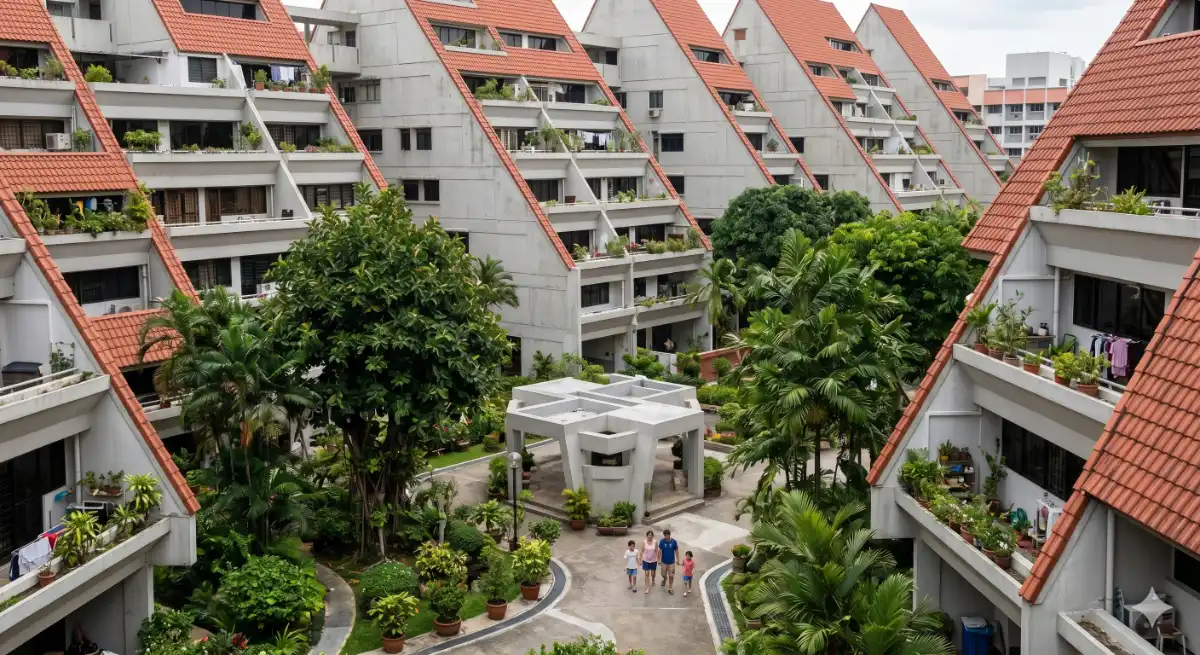
This is where it gets genuinely interesting. Because HUDC estates typically sit on large, centrally-located land parcels in mature towns, they have long been among Singapore's most attractive en bloc (collective sale) candidates or the Great Singapore En Bloc Lottery 😀
The track record speaks for itself:
- Farrer Court — sold en bloc to CapitaLand for approximately S$1.34 billion in 2007. It was redeveloped into d'Leedon.
- Shunfu Ville — sold en bloc for S$638 million in 2016. Redeveloped into Jadescape.
- Tampines Court — sold en bloc to Sim Lian for S$970 million in 2018. Being redeveloped into Treasure at Tampines.
The remaining HUDC estates — Braddell View, Pine Grove, Eunosville, Serangoon Ville and others — have either attempted en bloc or continue to be discussed as candidates. Their large site areas, mature locations, and aging infrastructure make them structurally attractive for redevelopment.
If you buy into a HUDC flat with en bloc potential, you are effectively buying a unit plus a lottery ticket. The payout if a collective sale happens can be very significant — often well above individual market value. But en bloc requires 80% owner consensus (or 90% for developments less than 10 years old), is subject to Strata Titles Board approval, and can take years of negotiation. It is not guaranteed.
The practical point for sellers: if an en bloc is imminent or in progress, selling individually is usually the wrong move. You want to stay for the collective sale payout. If no en bloc is on the horizon, selling individually works like any private property transaction — engage an agent, price it against recent comparable transactions, and go.
Should You Buy a HUDC Flat?
The honest answer depends on what you are buying it for.
For own stay with a family: HUDC flats can be excellent value. You get a large unit, a mature estate, and private property rules without paying new launch prices. The key is to buy one with enough lease remaining (ideally 65+ years) so that CPF and bank financing are not significantly constrained, and so the unit remains sellable when you eventually move on.
For investment and rental yield: The large unit sizes work against you here. Rental income does not scale proportionally with size — a 1,500 sqft HUDC 3-bedder does not command double the rent of a 750 sqft new launch 3-bedder. Your yield will be lower. This is not an income play.
For en bloc upside: You are speculating, and you should know that going in. Some HUDC estates have been trying for en bloc for years without success. Others will succeed. Research the specific estate's history, the current MCST sentiment, and what comparable nearby land is fetching before you price in any collective sale premium.
The lease is the one thing I would not compromise on. A HUDC flat with 50 years remaining has real financing and resale headwinds. One with 70 years remaining is a different proposition entirely. Do not let the attractive unit size or location blind you to that number.


Member discussion